Hippolyte's 'Necessary Explanation'
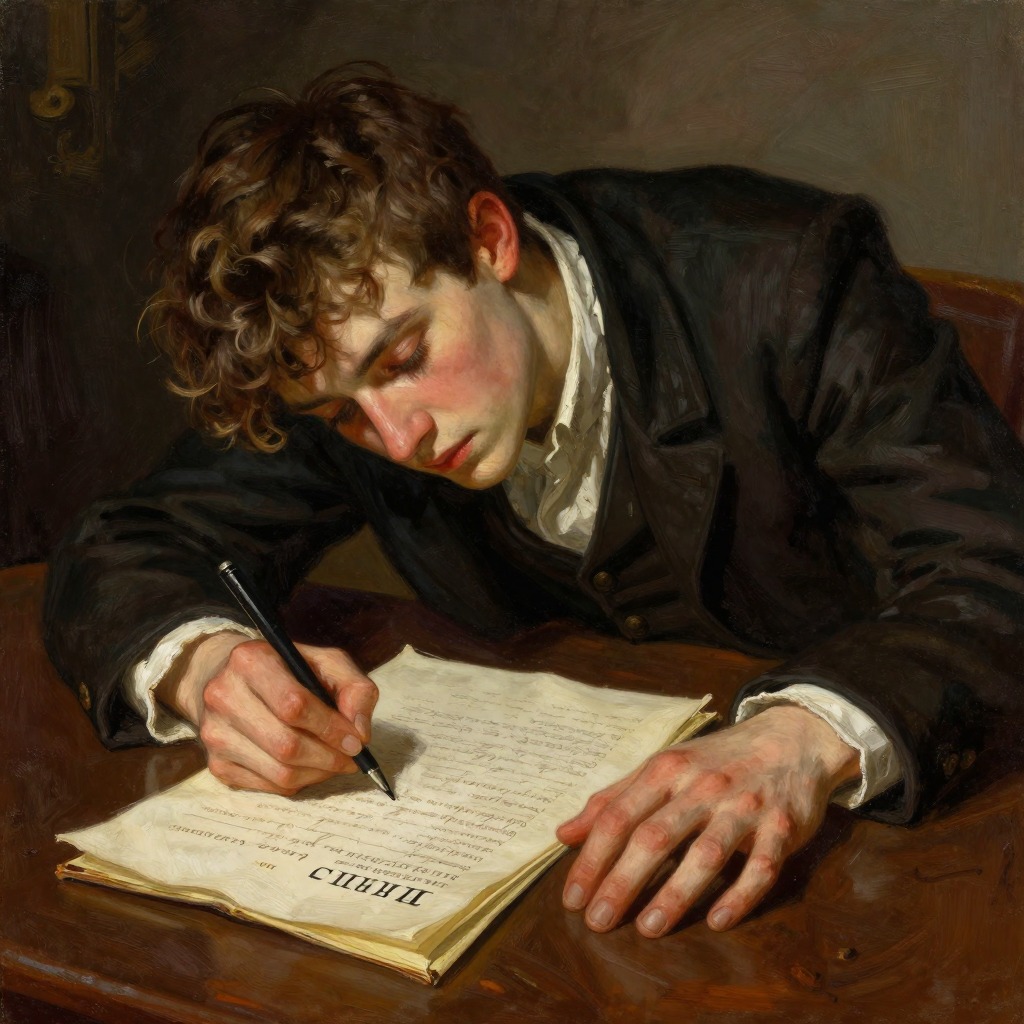
Hippolyte Terentieff's 'Necessary Explanation' is the most sustained and self-conscious piece of writing within the novel, a sealed document that the consumptive seventeen-year-old produces in a single day and night and insists on reading aloud to the assembled guests at Prince Muishkin's birthday party. It is at once a confession, a philosophical treatise, a suicide note, and a theatrical provocation. The reading itself becomes a dramatic event that reveals the depths of Hippolyte's despair, his hunger for recognition, and his ultimate inability to carry out his own final act.
Composition and Presentation
Hippolyte writes the 'Necessary Explanation' on the day after his first meeting with Muishkin in Pavlofsk, working through the entire day and night and finishing it early the following morning. He seals the manuscript with red wax, a gesture he later acknowledges was designed for maximum dramatic effect: "If I hadn't sealed it up it wouldn't have been half so effective!" The document is produced at the prince's birthday gathering late at night, when most of the guests are already tired and some are drunk. Hippolyte hesitates before reading, even tossing a coin to decide whether to proceed, and when it comes up heads he submits to what he calls "the fiat of destiny." The reading takes nearly an hour, and its effect on the audience is one of growing discomfort, irritation, and finally alarm.
Content and Themes
The manuscript is a sprawling, feverish text that ranges across several registers. It begins with a detailed account of a nightmare involving a monstrous, scorpion-like reptile that Hippolyte interprets as an embodiment of the dark, implacable force of nature. From this dream he moves into a sustained meditation on his own approaching death from consumption, which a medical student has told him will come within a month. He recounts an episode in which he helped a destitute doctor and his family, an act that briefly gave him a sense of purpose, but this is followed by a visit to Rogojin's gloomy house and the contemplation of Holbein's painting of the dead Christ, which he describes as a depiction of nature as "some huge, implacable, dumb monster" that has crushed and swallowed up a Being worth the whole earth. The core of the 'Explanation' is a philosophical argument for the right to suicide. Hippolyte insists that a man with only a fortnight to live has no obligation to endure that time passively, and that his decision to end his own life is a legitimate act of protest against a universe organized on principles he cannot accept. He rejects the consolations of religion, nature, and human sympathy, declaring that he will die "gazing straight at the great Fountain of life and power" and that he does not want this life.
The Failed Suicide and Its Aftermath
The reading concludes with Hippolyte's announcement that he will shoot himself at sunrise. He produces a small pocket pistol, but when he raises it to his temple and pulls the trigger, there is only a metallic click: he has forgotten to put a cap on the pistol. The anticlimax is devastating. Hippolyte collapses into hysterical sobbing, insisting that the omission was an accident, and begs for the pistol to be returned so he can try again. The guests react with a mixture of mockery, pity, and irritation. Keller, who had suspected something, declares that anyone who doubts Hippolyte's sincerity will have to answer to him. The prince, who had tried to prevent the reading, is deeply shaken. Evgenie Pavlovitch later tells Muishkin that Hippolyte is "quite capable of cutting the throats of ten people, simply for a lark," as he had threatened in his manuscript. The 'Necessary Explanation' thus ends not with a death but with a humiliation, leaving Hippolyte more isolated and embittered than before, and casting a long shadow over the remainder of the novel.